
 Resources
Benefits of Teen Meditation: What the Research Shows
Published On 01-11-2026
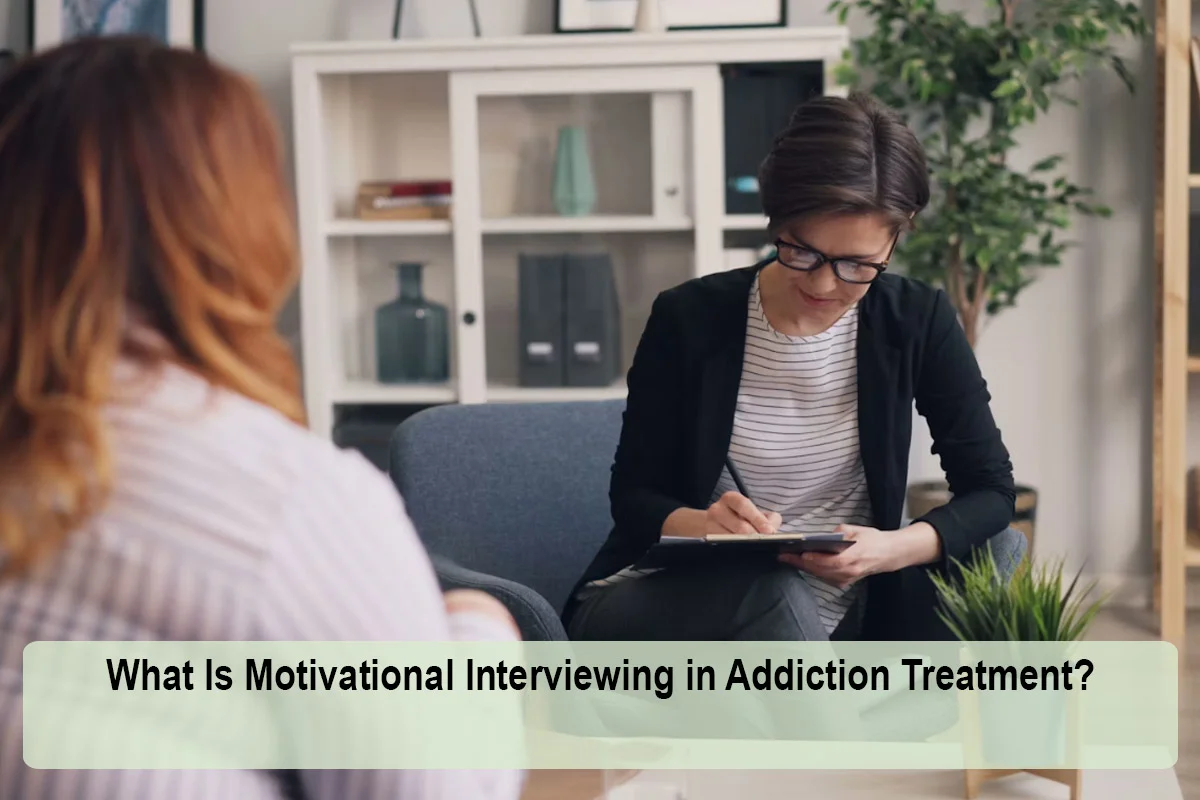
If you've read our guide to talking to someone about going to rehab, you've already encountered pieces of motivational interviewing applied to a family conversation. This piece is different: it explains motivational interviewing (MI) as the clinical therapy itself, the modality a counselor uses inside a treatment program, so you know what to expect and how to evaluate whether a facility is actually practicing it well.
Motivational interviewing was developed by psychologists William Miller and Stephen Rollnick, first published in the late 1980s and refined across multiple editions since. Miller and Rollnick define it as a collaborative, person-centered form of guiding to elicit and strengthen a person's own motivation for change. The key word is elicit: MI is built on the premise that the reasons for change need to come from the person themselves, not be supplied by the counselor, because people are consistently more persuaded by their own arguments than by someone else's.
This stands in direct contrast to an older, more confrontational counseling style once common in addiction treatment, where a counselor would directly challenge a client's denial, argue against their rationalizations, and push hard toward acknowledgment of a problem. Miller and Rollnick call the counselor's instinct to fix, correct, or argue someone into change the "righting reflex," and MI is built specifically to resist that instinct, because research consistently shows that confrontation tends to increase defensiveness rather than motivation.
MI is also grounded in a distinction between two kinds of client speech that Miller and Rollnick's research identified as clinically meaningful: change talk, statements in favor of change, and sustain talk, statements defending the status quo. A core skill in MI practice is learning to recognize both in real time and to respond in ways that increase the ratio of change talk to sustain talk over the course of a conversation, since the balance between the two has been shown to predict actual behavior change with reasonable reliability.
Miller and Rollnick describe an underlying stance, called the "spirit" of MI, that has to be present for the technique to actually work. It consists of four qualities:
This spirit is not optional decoration around the technique; it is the foundation the technique depends on. Research on MI implementation has found that when clinicians use MI's specific verbal techniques without genuinely holding this underlying spirit, the approach tends to collapse into something that looks like MI but functions as manipulation, and its effectiveness disappears. This is one of the more important, underappreciated findings in the research on MI: the spirit and the skills are not separable components you can use independently and expect similar results.
| Process | What Happens |
|---|---|
| Engaging | Establishing a working relationship and basic trust before attempting any substantive work on change |
| Focusing | Collaboratively identifying a specific direction or goal for the conversation, rather than addressing everything at once |
| Evoking | Drawing out the client's own motivations, reasons, and arguments for change, specifically eliciting what MI calls "change talk" |
| Planning | Developing a concrete plan once sufficient motivation and confidence for change have emerged, moving from why to how |
Miller and Rollnick describe these four processes as stairs rather than a strict linear sequence: later processes build on earlier ones, but a skilled practitioner moves back and forth between them as needed within a single conversation, returning to engaging if trust wavers, or back to focusing if a new, more pressing goal emerges mid-session.
The specific communication techniques MI counselors use to execute this approach are commonly remembered by the acronym OARS: open-ended questions, affirmations, reflective listening, and summarizing. These are the same techniques our guide to talking with a loved one about treatment covers in a family context, and seeing them here as formal clinical skills, taught and assessed in professional MI training and certification, underscores that they are not simply intuitive communication tips; they are a trained, evidence-based clinical technique with a specific evidence base behind their use.
MI has been evaluated in more than 200 randomized controlled trials across substance use, diet, exercise, and medication adherence. Across this body of research, MI generally produces small-to-moderate effect sizes, meaningful and reliable, though not dramatic, improvements compared to no treatment or to standard advice-giving approaches. What makes this notable clinically is efficiency: MI often produces outcomes comparable to considerably longer therapeutic approaches in a fraction of the contact time, which is part of why it has become a standard component, often used as an entry point or ongoing thread, within many addiction treatment programs rather than a rarely used specialty technique.
It is worth being precise about what "small-to-moderate effect size" means in practical terms, since headlines about therapy research often obscure this. An effect size in this range means MI reliably outperforms doing nothing or offering generic advice, but it does not mean MI alone resolves a severe substance use disorder on its own in every case. This is exactly why MI is most commonly used as one component within a broader treatment plan, often paired with cognitive behavioral therapy, medication where appropriate, and other evidence-based approaches, rather than deployed as a standalone cure. Understanding this helps calibrate expectations: MI is a genuinely well-supported technique for building and sustaining motivation, a critical ingredient in successful treatment, but it is not, by itself, the entire treatment.
These terms are sometimes used interchangeably, but they are not quite the same thing. MET is a specific, manualized, typically time-limited treatment protocol built on MI principles, often incorporating structured personal feedback about a client's substance use compared to population norms, delivered across a defined number of sessions. MI itself is broader: a general counseling style and set of skills that can be woven into many different types of sessions and combined with other approaches, such as cognitive behavioral therapy, rather than a fixed, standalone protocol. A program might describe itself as MI-informed throughout treatment, or might specifically offer MET as a defined early-treatment intervention; both reflect the same underlying research tradition, applied differently.
Consider two counseling sessions addressing the same client's ambivalence about reducing alcohol use. In a confrontational style, the counselor might directly list the negative consequences of the client's drinking and push them to agree these are serious problems. In an MI-consistent session, the counselor instead asks an open question, "what have you noticed about how drinking is affecting things for you," reflects back what the client says without adding judgment, and gently explores any discrepancy the client themselves identifies between their drinking and their own stated values or goals. The second approach is doing real clinical work, not simply being gentler for its own sake; it is specifically engineered to generate change talk, the client's own stated reasons for change, which research consistently shows predicts actual behavior change more reliably than a counselor's arguments ever do.
Understanding MI gives you a concrete way to evaluate whether a program's described approach is genuinely evidence-based or simply uses the language without the substance. Ask a facility directly whether and how their counselors are trained in motivational interviewing, whether that training includes ongoing skills coaching (since MI proficiency, like any clinical skill, degrades without practice and feedback), and whether MI is integrated throughout treatment or used only briefly at intake. A facility that can describe specifically how its clinical staff maintain MI fidelity over time, through supervision, recorded session review, or ongoing training, is signaling a more serious commitment to the approach than one that simply lists "motivational interviewing" among a long menu of therapy buzzwords on a website without further detail. Our guide to what evidence-based treatment actually looks like covers how to evaluate a program's clinical approach more broadly, and our guide to choosing a rehab center is a useful next stop for the broader selection process.
This article was reviewed by the RehabsNearMe Editorial Team for accuracy, clarity, and relevance. Information may be sourced from publicly available treatment resources, government agencies, and healthcare references where applicable.
Last reviewed: September 2026
Resources
 Resources
 Resources
 Resources